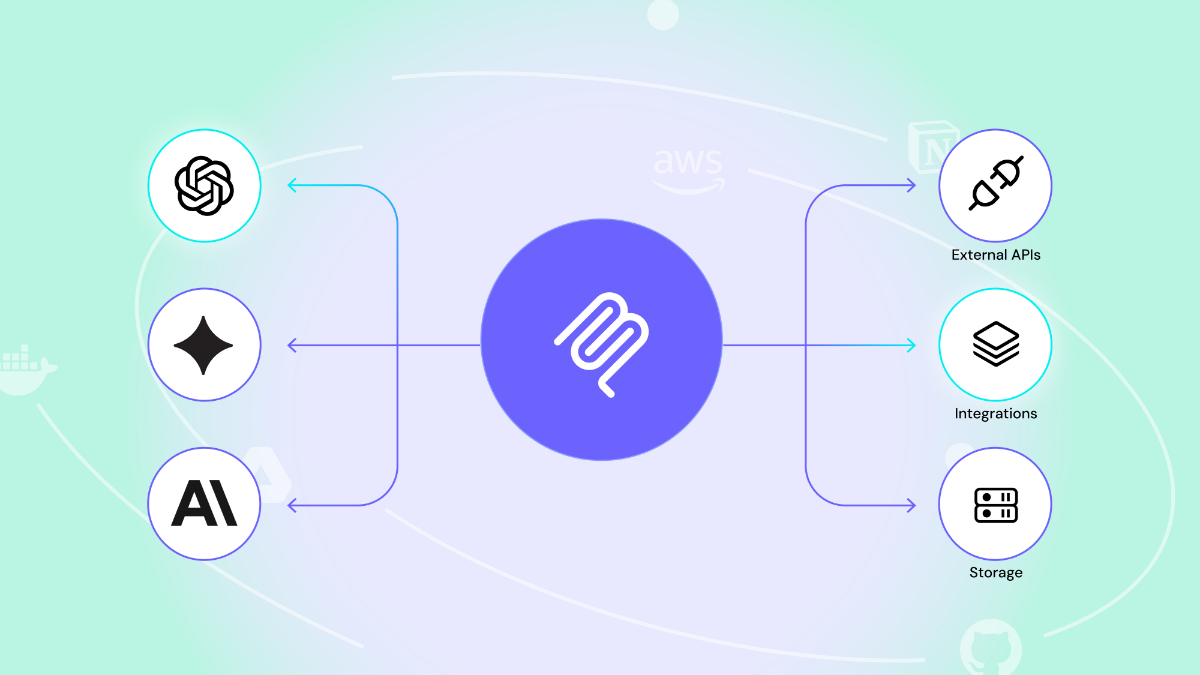
Artificial intelligence is evolving fast and one of the most significant shifts happening right now isn’t about the AI models themselves. It’s about how those models connect to the world around them.
Until recently, AI systems were largely isolated. They knew what they were trained on, and that was it. Getting them to interact with your business tools, databases, or real-time data required a lot of expensive, bespoke development work. That’s changing thanks to something called the Model Context Protocol, or MCP.
If you’ve been hearing this term thrown around and wondering what it actually means for your business, this guide is for you.
What Exactly is the Model Context Protocol?
MCP is an open standard introduced by Anthropic in late 2024 that defines how AI models communicate with external data sources and tools. Think of it as a universal plug for AI. Rather than building a custom connection every time you want your AI assistant to talk to your CRM, your database, or your calendar, MCP provides a shared language that works across platforms.
The analogy that tends to resonate: MCP is to AI what USB-C is to devices. One standard connector, endless compatibility.
Before MCP, connecting an AI model to an external tool meant writing custom integration code for every single combination. Now, if a tool supports MCP and so does your AI model, they can communicate straight out of the box.
Why Does This Matter for Your Business?
The practical implications of MCP are significant. Here’s what it unlocks:
AI that works with live data. Previously, AI assistants could only draw on their training data which has a cutoff date and doesn’t know anything specific about your business. With MCP, an AI can query your actual systems in real time. It can pull up a customer record, check inventory levels, or retrieve the latest project notes all within a conversation.
Faster, cheaper AI development. Without MCP, every integration between an AI model and a business tool required custom development work. MCP eliminates most of that overhead. Developers can build once against the standard, rather than rebuilding the same bridge repeatedly for every tool combination.
More capable AI workflows. MCP enables AI agents systems that can take actions on your behalf to work reliably across multiple tools. An AI assistant that can read your emails, update your project management system, and schedule a follow-up meeting, all from a single instruction, is only possible with reliable, standardised connections. MCP makes that kind of multi-step automation practical.
Modular, flexible architecture. MCP is designed to be modular. You can add or remove tools from your AI setup without rebuilding the entire system. As your technology stack evolves, your AI capabilities can evolve with it.
How Does MCP Actually Work?
At a technical level, MCP uses a client-server architecture. There are three key players:
- The MCP Host: this is the AI assistant or application making requests (for example, Claude, or an AI-powered business tool you’re using).
- The MCP Client: the middleware layer that routes requests between the host and external services.
- The MCP Server: the individual tools or data sources that the AI needs to interact with (your CRM, a database, a file storage system, etc.).
When your AI needs information or needs to perform an action, it sends a request through the client to the relevant server. The server responds with the data or confirms the action. The whole exchange follows the MCP standard, so it’s consistent, predictable, and secure.
Sessions are used to manage ongoing interactions meaning a multi-step task can be paused and resumed without losing context. Before any client and server start working together, they negotiate which capabilities and protocol versions they each support, keeping everything compatible.
Real-World Applications
MCP isn’t theoretical. It’s already being used in meaningful ways:
Smarter chatbots and virtual assistants. Customer-facing AI tools that can access live order data, account information, or knowledge bases rather than generic canned responses deliver a dramatically better experience. MCP is what enables that real-time data access.
Retrieval-Augmented Generation (RAG). This is a technique where AI pulls in relevant documents or data at the time of a query, rather than relying solely on training data. MCP standardises how that context gets delivered, making RAG systems more reliable and easier to build.
AI-powered automation. AI agents that can autonomously complete multi-step tasks such as processing a support request, updating a record, or sending a notification need reliable connections to multiple systems. MCP provides the standardised plumbing that makes this possible without it falling apart when one tool changes.
Development tools and IDEs. Developers are using MCP-connected AI tools that can read codebases, run queries, access documentation, and interact with version control all within their usual workflow.
What Are the Current Limitations?
MCP is still maturing, and there are some genuine limitations worth being aware of:
Authentication is a work in progress. Currently, most MCP implementations rely on API keys for authentication. For many use cases this is fine, but enterprise environments that require OAuth, token-based auth, or integration with existing identity providers will find current options limited. This is an area the community is actively developing.
Data governance gaps. For regulated industries like finance, healthcare, legal etc, MCP’s current framework around compliance, auditing, and data governance may not yet meet requirements. This doesn’t mean it can’t be used in these sectors, but it does mean additional controls will need to be layered on top.
Evolving standards. As with any emerging standard, there’s a risk of breaking changes as MCP develops. Teams building on MCP should keep an eye on the roadmap and plan for some version management overhead.
These aren’t reasons to ignore MCP, in fact quite the opposite. Getting familiar with it now positions your business well as the standard matures and these gaps are addressed.
The Bigger Picture
We’re at a point in AI development where the raw capability of models is no longer the main bottleneck. The challenge is connectivity, getting AI to work reliably with the real-world data and tools businesses actually use. MCP is the most significant step toward solving that problem.
For businesses, this means the AI tools you adopt in the next few years will increasingly be built on MCP or compatible standards. Understanding what it is and what it makes possible puts you in a better position to evaluate those tools and the AI strategies built around them.